If there is one thing I can’t stand is being busy because there is no system in place. It irritates and frustrates me. I feel like a prisoner doing mindless work.
The problem is not that I am lazy. The problem is not even that I do not understand the value of publishing. I do. The problem is that social media creates a strange operational requirement: you can have something useful to say, but you are expected to repeatedly translate that idea into different formats, write the accompanying copy, create images, schedule everything, and then do it again tomorrow.
That is a systems problem. So I built a system to handle most of it.
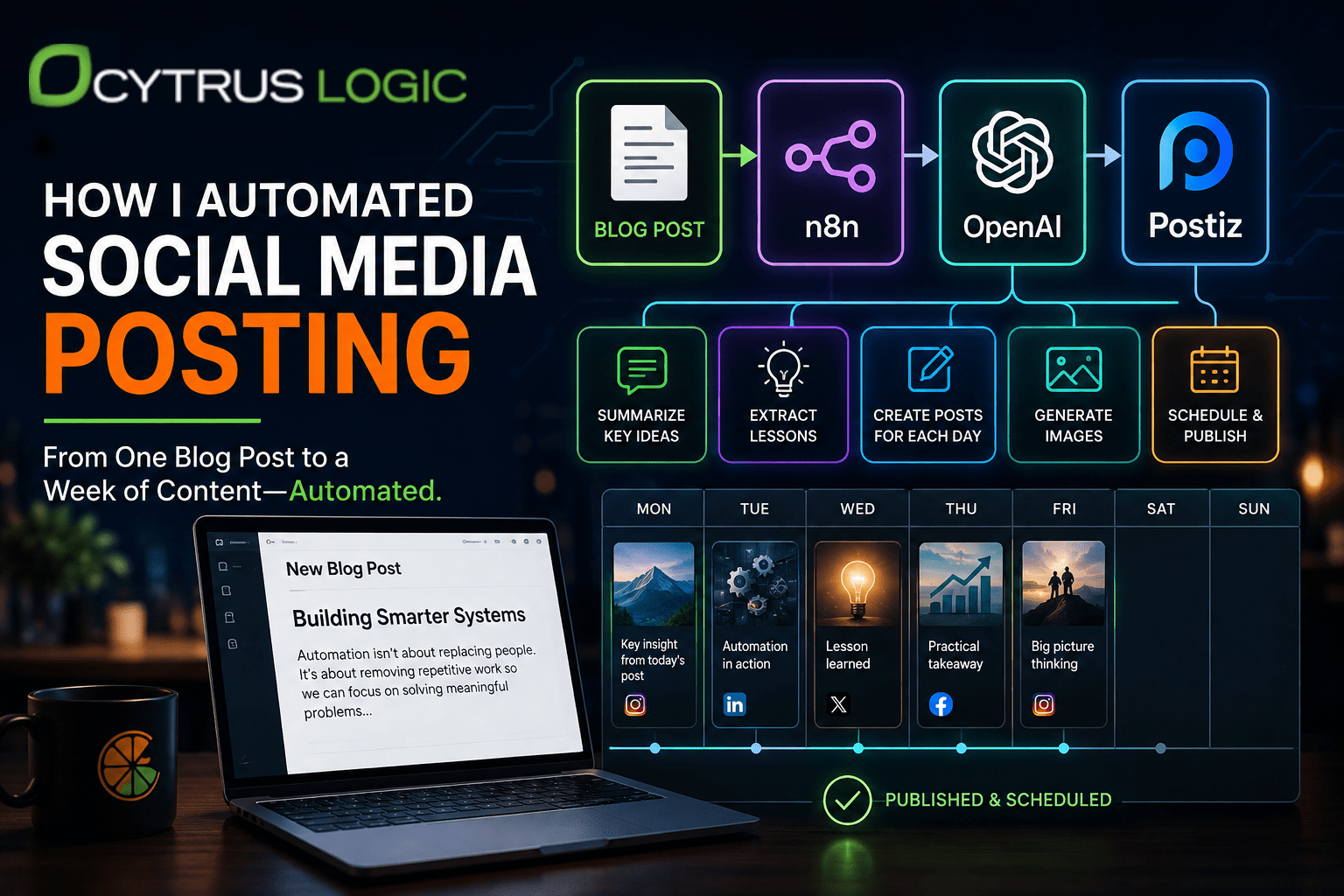
The basic idea is simple. I start with something I actually want to write about, usually a blog post. From there, an n8n workflow uses OpenAI to analyze the article, identify the important ideas, generate social posts, create prompts for images, and prepare the content for publication through Postiz.
The interesting part is not that AI can write a social media post. That is relatively trivial. The interesting part is the translation process between one piece of source material and many different pieces of communication.
One Article Becomes the Source
The system starts with a blog post. I do not want the AI inventing my content from nothing. The blog post is the source document. It contains the argument, examples, observations, and conclusions that I actually want to communicate. The automation then treats that article as a kind of semantic source. Instead of asking: “Write me five social media posts.” I actually ask: “What information exists in this article, and how can that information be expressed in several different contexts?” That is a much better solution.
A single article might contain several independent ideas. It might have a central argument, three supporting observations, a practical example, a counterargument, and a conclusion. Those components can become separate social posts without simply copying paragraphs from the original article. This is essentially a content decomposition problem. The workflow takes a relatively high-dimensional piece of content and decomposes it into smaller communicative units. Those units can then be recombined for different platforms and purposes.
n8n Becomes the Orchestration Layer
I use n8n to connect the different parts of the system. This is where automation becomes more interesting than simply asking ChatGPT to generate a post. n8n handles the flow of information between the different services. The article enters the workflow, gets processed by OpenAI, and the resulting structured content is passed to the next stages. Conceptually, the workflow looks something like this:
Blog Post → Content Analysis → Ideas → Social Posts → Images → Schedule → Publication → Analysis
Each stage has a different responsibility. The blog post provides the information. OpenAI performs the linguistic and semantic transformation. The image-generation process provides the visual representation. Postiz handles publication and scheduling. n8n coordinates the entire process. That means that I can change one component without having to rebuild the entire system. If I decide to change the social publishing platform, I do not need to redesign the content-generation logic. If I change the image-generation system, the rest of the workflow can remain largely intact. This is one of the advantages of thinking about automation as architecture rather than as a collection of individual AI prompts.
The AI Is Not Just Writing. It Is Interpreting.
One of the more useful things I have found is to have the AI perform several different passes over the same source material. The first pass identifies the important concepts. The next pass turns those concepts into potential social-media ideas. Another stage adapts those ideas into platform-specific posts. Then the system can generate an appropriate visual concept for each post.
This creates a hierarchy:
Source → Concepts → Messages → Platform-specific content → Visuals
That hierarchy is important because each transformation has a different purpose. A blog post and a social-media post are not the same kind of communication. A blog post has enough space to establish context, develop an argument, introduce evidence, and explain qualifications. A social post generally does not. Simply shortening the article, therefore, produces bad content.
The better approach is to identify the underlying idea and reconstruct the communication around it. For example, suppose I write an article explaining why a particular business process fails because information is fragmented between several systems. The article might spend 1,500 words explaining the mechanism. A social post does not need those 1,500 words. Instead, the system might identify one specific insight:
The problem is not that employees lack information. The problem is that the information exists in disconnected systems.
That becomes the core of one post. Another post might use the same article to explain the operational consequence. Another might present the practical solution. The source remains the same, but the communication changes.
Every Day Gets Its Own Content
I also do not want to publish essentially the same post five times. The workflow therefore generates a series of posts from the underlying material and assigns them to different days. This creates something closer to an editorial calendar than a queue of AI-generated text. One day might focus on the central argument. Another might focus on a practical lesson. Another might use an example. Another might present a counterintuitive observation. Another might summarize the larger implication. The result is that the audience encounters the same underlying body of knowledge from different angles. That is useful because repetition and redundancy are not necessarily the same thing. If I publish the exact same message repeatedly, I am creating redundancy. If I explain the same underlying concept through several distinct examples, I am creating reinforcement. That distinction matters in communication.
Images Are Part of the Same Pipeline
The workflow also generates image concepts for the individual posts. This is another place where the source article becomes useful. Rather than generating a random stock-style image for every social post, the system can use the meaning of the post to determine what the visual should communicate. If the post is about fragmented information, the image might represent disconnected systems. If the post is about automation, the visual might represent a process moving through several stages. If the post is about a particular technology, the image can be constructed around the actual subject of the post. The goal is not simply to put an image next to the text. The goal is to make the image another representation of the same underlying idea. In other words, the text and image are two outputs of the same semantic source.
Then Postiz Takes Over
Once the content and images have been generated, I use Postiz to handle publishing and scheduling. This is where the system crosses the boundary from content generation into operations. The workflow can prepare the posts, associate the appropriate media with them, and schedule them for publication. That means the original blog post can effectively become the beginning of a publishing cycle rather than the end of one. I write once. The system then performs the repetitive translation and scheduling work.
This does not mean I never review the content. I still want editorial control, particularly when the subject involves something technical, controversial, or important enough that an imprecise statement could change the meaning. Automation should remove repetitive labor. It should not remove judgment.
Learning from the Content
I have also started using AI to summarize the content and extract lessons from the posts themselves. This creates another layer in the system. The initial workflow asks: What can I publish from this article? The later workflow asks: What did I learn from publishing this content? That is a different question. For each day’s content, AI can summarize the main ideas, identify recurring themes, and extract lessons that might be useful for future content. Over time, this creates a feedback loop. The process becomes:
Write → Decompose → Publish → Observe → Summarize → Learn → Write
The important part is the feedback loop. Without it, automation simply increases the volume of content. With it, the system has the possibility of improving the content strategy itself.
This Is Really a Content Compiler
The way I think about the system is similar to a compiler. A compiler takes a source representation and transforms it into another representation while preserving the underlying meaning. That is approximately what is happening here. The blog post is the source representation. The AI identifies its semantic structure. The workflow transforms that structure into platform-specific representations. The image system creates a visual representation. Postiz transforms those representations into scheduled publications.
The underlying ideas remain connected even though their surface forms change. This is a useful mental model for AI automation in general. The goal is not necessarily to have AI generate everything. The goal is to identify where information needs to be translated between representations and automate those translations. That is often where the repetitive work actually exists.
Why I Prefer This Approach
There is a temptation to think of AI automation as replacing the person who creates content. That is not how I use it. The valuable part of my work is still deciding what I think is worth saying. I decide what problems are interesting. I decide what I believe. I write the longer-form material. The automation handles much of what happens afterward. This division of labor makes sense because humans are still better suited to deciding what deserves attention, while machines are very good at performing repetitive transformations of structured information. Once that distinction is clear, the architecture becomes fairly obvious.
Humans provide the source material and judgment. AI performs interpretation and transformation. Automation moves information between systems. Publishing infrastructure handles distribution. Analytics and feedback provide information for the next iteration. That is a much more useful model than simply saying, “AI writes my social media.”
The Bigger Lesson
The interesting thing about this system is not the individual technologies. n8n is useful. OpenAI is useful. Postiz is useful. But none of them, individually, solves the underlying problem. The useful system emerges from the relationships between them.
The blog post provides the semantic source. OpenAI transforms that source. n8n orchestrates the transformations. Postiz distributes the resulting content. The feedback process creates information that can influence what gets written next. That is a small example of a much larger principle in automation: The highest-value automation is often not about automating a task. It is about connecting tasks that were previously disconnected. Writing a social-media post is easy to automate.
Building a system that understands where that post came from, creates multiple useful representations of the underlying idea, distributes them over time, and feeds the resulting lessons back into the content process is considerably more interesting. That is the system I am building at Cytrus Logic. Not an AI that replaces the writer. A pipeline that lets the writer’s ideas travel much farther.