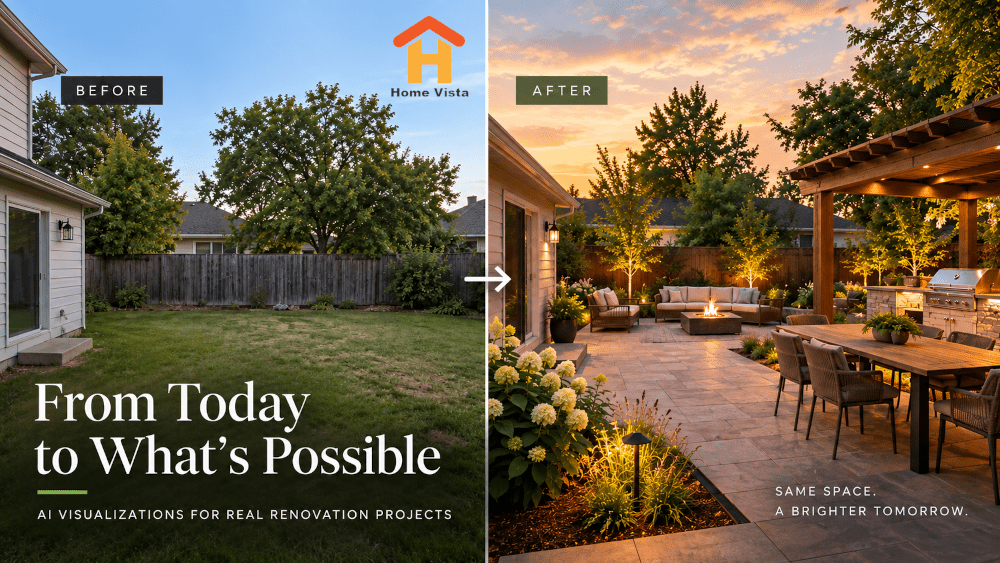
There is a strange problem in the home renovation business. A contractor can look at a kitchen, bathroom, backyard, or living room and immediately see what could be done with it. The homeowner standing next to them often sees exactly the same room they have been looking at for the last five or ten years.
The contractor is thinking in terms of possibilities. The customer is looking at the present.
That difference creates a communication problem that is easy to underestimate. A renovation company may have years of experience, technical knowledge, pricing information, material catalogs, measurements, and a carefully developed proposal, but none of those things necessarily communicate what the finished project will actually feel like.
This is the problem that led me to create HomeVista.
The customer is buying something that does not exist yet
When someone hires a company to remodel a kitchen, build a patio, redesign a yard, replace a bathroom, or renovate a living space, they are making a decision about a future state.
The difficulty is that the future state is difficult to perceive.
A contractor might say, “We can remove this wall, install larger cabinets, add an island, change the flooring, and use this style of lighting.” To someone who understands construction and interior design, that description can be enough to construct a mental model of the finished space.
For the homeowner, it may not be.
This is partly a cognitive problem. People are generally much better at interpreting information that corresponds to something they can perceive than information that requires them to construct a hypothetical spatial model in their heads. A photograph of a finished kitchen contains an enormous amount of information immediately. A paragraph describing a future kitchen does not.
This creates an interesting asymmetry between the person selling the renovation and the person buying it. The professional has accumulated experience that allows them to mentally simulate the result. The customer has not.
The professional therefore sees the renovation before it happens.
The customer has to imagine it.
That distinction matters because imagination introduces uncertainty, and uncertainty affects decisions.
Renovation proposals are often information-rich but visually poor
Most renovation companies already understand that customers need information. That is why proposals can contain measurements, material selections, product specifications, estimates, drawings, photographs, and descriptions of the proposed work.
The problem is that information does not automatically produce understanding.
Suppose a homeowner is considering replacing an outdated patio with a larger entertaining area. The proposal might specify new pavers, seating, landscaping, lighting, a pergola, and an outdoor kitchen. Every individual component can be described accurately, but the customer still has to combine those descriptions into a single mental representation.
This is where visualization becomes useful.
A generated visualization can take the existing space as the starting point and represent what that space could look like after the proposed changes. Instead of asking the homeowner to mentally integrate six or seven separate pieces of information, the visualization provides a single perceptual object around which those pieces can be understood.
The image becomes a kind of interface between the technical proposal and the customer’s imagination.
That is the underlying idea behind HomeVista.
HomeVista is built around the gap between what exists and what could exist
HomeVista uses AI-generated visualizations to show homeowners what a proposed renovation could look like before construction begins.
The important part of that description is “could look like.”
A visualization is not a construction drawing, and it should not be treated as one. Its purpose is different. It provides a visual representation of a proposed direction so that the customer can begin evaluating the idea in concrete terms.
This distinction is important because the value of visualization does not come from pretending that an AI image is an exact architectural representation. The value comes from reducing uncertainty about the concept.
Consider a landscaping company showing a homeowner a photograph of their current backyard and then describing a new outdoor living area. The customer has to imagine the transformation.
Now consider showing that same customer a visualization of their backyard with the proposed patio, planting, seating area, lighting, and other elements incor